
Revolution in IT: How AI Is Powering the Next Frontier in DEX
AI is foundational to amplifying performance across all business functions—especially in IT with digital employee experience (DEX) management.
ChatGPT launched in November 2022 to much fanfare and media attention. Since that time, AI has completely dominated headlines, boardroom discussions, and strategic roadmaps. It’s become virtually impossible to ignore.
Everywhere you look, there’s another warning about job displacement or questionable returns. MIT researchers have questioned AI’s ROI, while EY and others argue the opposite—that tangible business value is already here. Jamie Dimon recently said JPMorgan’s $2 billion AI investment has already matched its cost in savings.
In reality, both can be true. Like any transformative technology, the outcomes depend on how thoughtfully it’s applied. With AI, the “cat’s out of the hat,” so they say, but the businesses that learn how to harness its powerful capabilities will gain a real competitive edge.
The Reality: AI as a Force Multiplier
There’s a reason why AI adoption continues to accelerate across every industry. When applied correctly, AI becomes a force multiplier. It sharpens decision-making, accelerates innovation, and raises the overall performance bar. AI can turn the average performer into a top performer, scale expertise across teams, and remove friction that slows progress. According to Deloitte, confidence in AI automation ROI is so strong that more than 95% of companies expect large or very large returns in the coming year.
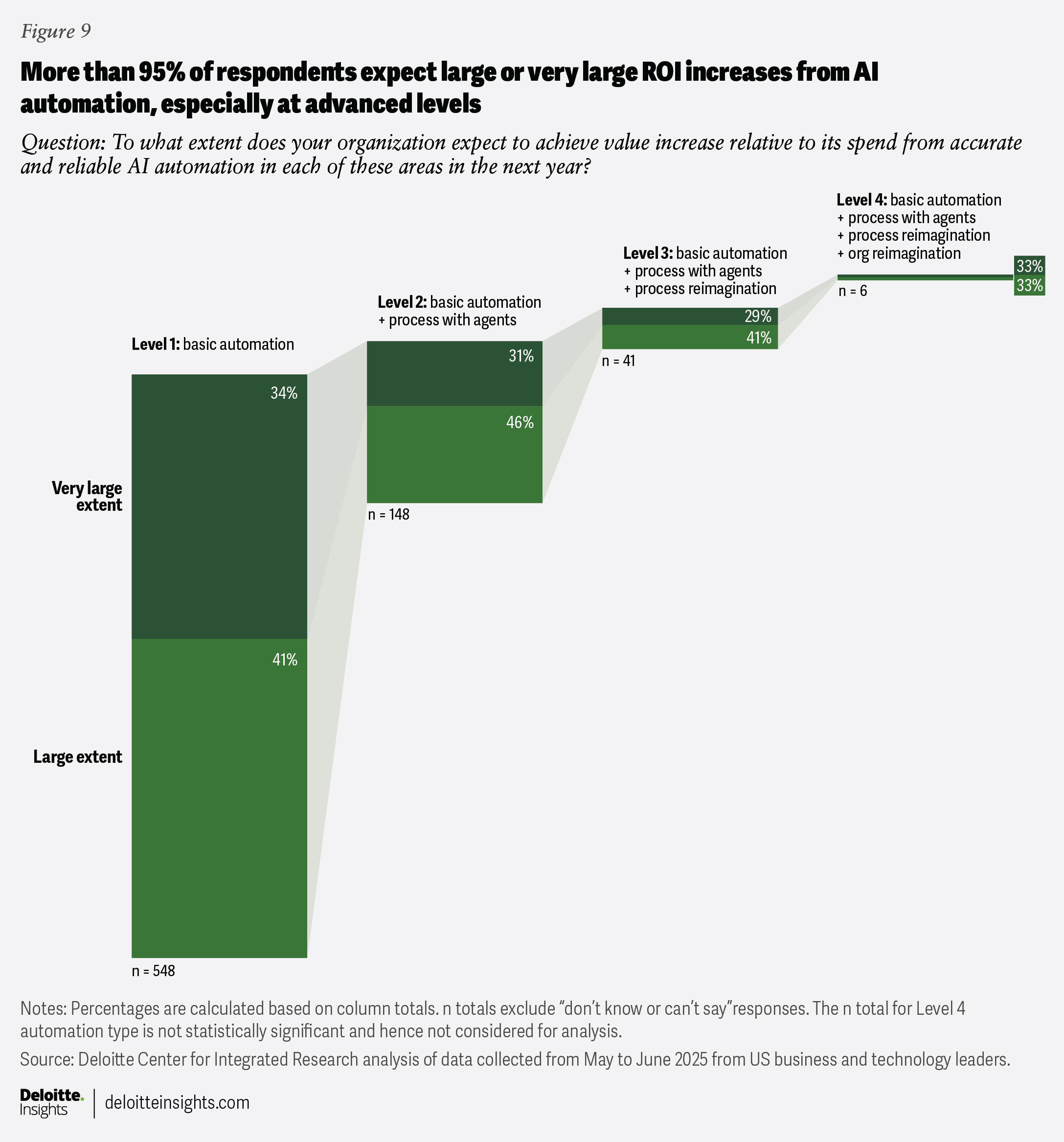
Source: Deloitte
However, AI must deliver value, and this is especially true in IT.
As digital employee experience (DEX) becomes central to organizations’ operations, AI offers an opportunity to make technology work better for employees, improving productivity, engagement, and fulfillment across the workforce. What many leaders tend to struggle with is how and where to begin.
A Strategic Approach to AI Adoption
First, organizations should start with use cases. By identifying one or several that matter most, they can model out the potential impact and then pursue the ones that offer the greatest value in that function or business. This is not much different from product management, where you begin with a hypothesis but also map out all the reasons it might fail before you build.
Keep in mind, large language models (LLMs) are powerful for answering questions and working with messy information, but they’re not the right fit for every scenario. Deterministic problems are better suited to traditional data science models, while predictive capabilities may require regression, Bayesian, or math-centric approaches. The key is to match the use case with the right type of AI and then validate that it can deliver real ROI.
The next step is to apply the crawl, walk, run approach.
- Crawl: Start small. Test AI on a narrow, repeatable task like classifying data or automating simple requests and prove it delivers value. The focus is on building confidence, spotting blind spots, and understanding how people respond.
- Walk: Expand carefully. Take what worked, layer in more automation, and introduce feedback loops that help the system improve. For example, a pilot working for one team may extend across departments.
- Run: Scale with confidence. Once ROI is proven and safeguards are in place, AI can shift from assistive to proactive, driving continuous improvement, predicting outcomes, and handling routine work end-to-end.
Finally, safeguards are simply the next evolution of quality assurance. You wouldn’t push untested software into production; AI is no different. Humans “in the loop” are essential, while the level of QA depends on the stakes. Light checks may be acceptable for low-risk automation, but mission-critical systems demand the highest rigor. Building in this discipline ensures AI adoption stays reliable, trustworthy, and aligned to real outcomes.
AI in IT: The Digital Employee Experience Revolution
IT departments are at the forefront of AI adoption, especially through DEX management platforms. These tools use AI to improve service delivery, system reliability, and employee productivity.
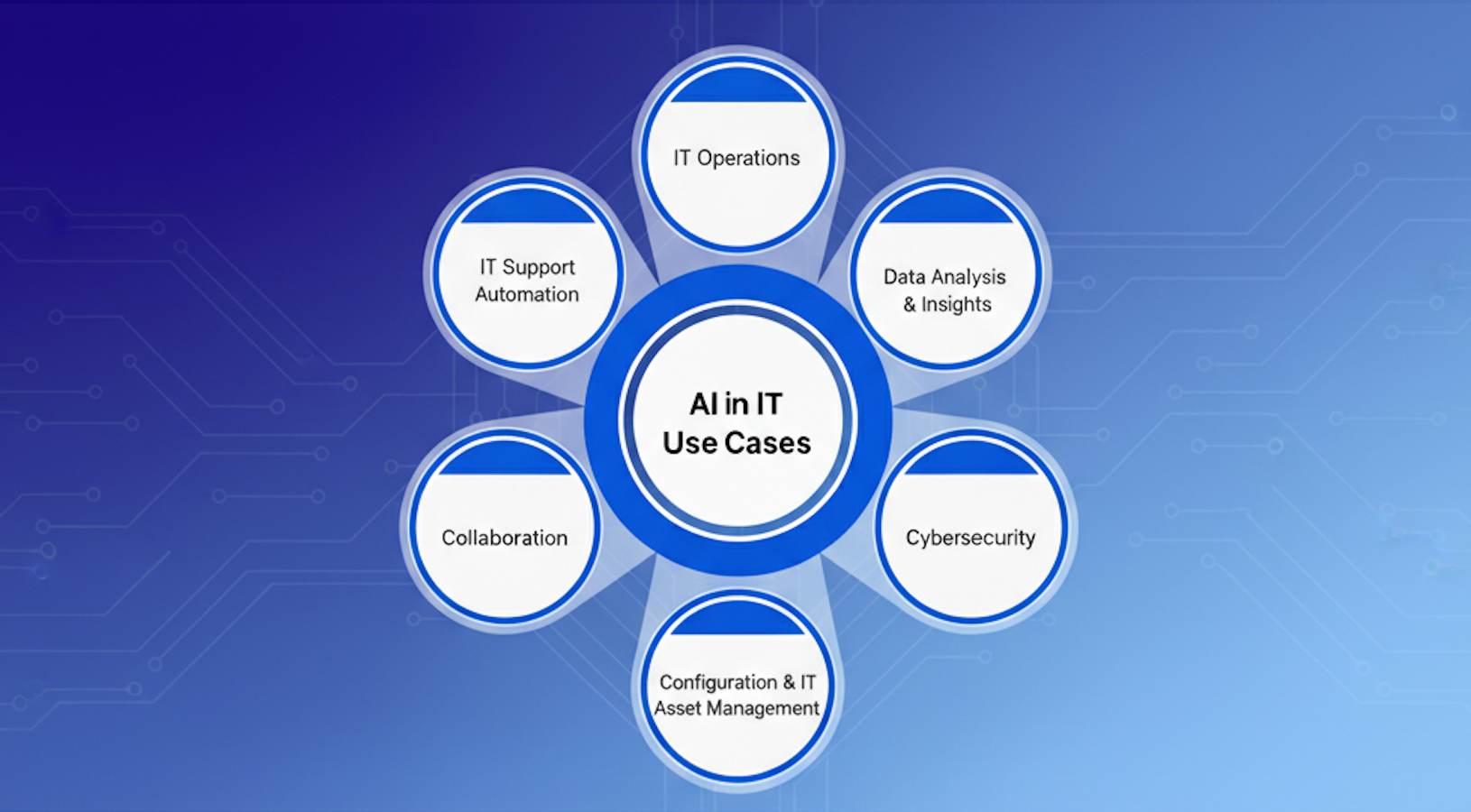
Soon, I believe AI can help improve uptime toward 99.999% availability, personalize every employee’s experience, and even bring IT and HR closer together as workforce and technology functions converge. Most importantly, it can shift IT’s role from reactive maintenance to proactive problem-solving, freeing up time to focus on innovation and growth. Key use cases include:
- IT Operations – Automate incident detection, root cause analysis, and alerts; enable self-healing and optimize resources.
- IT Support Automation – AI agents can handle tier-1 support, classify tickets, and recommend resolutions, improving response times while freeing human agents for higher-value work.
- Data Analysis & Insights – Accelerate anomaly detection and decision-making.
- Cybersecurity – Enhance threat detection, behavioral analysis, and automated response by monitoring telemetry across systems, apps, and networks.
- Configuration & IT Asset Management – Organize configuration data, track assets, and optimize infrastructure performance.
- Collaboration – Improve audio and video quality, detect anomalies that negatively affect technology performance and/or user experience in real time, and reduce meeting disruptions.
The Path Forward
The importance of delivering tangible value cannot be overstated. For IT departments, the journey begins with optimizing DEX and evolves into a future where AI systems drive continuous improvement. To fully realize the benefits of AI, IT and business leaders must take a crawl, walk, run approach by starting with carefully thought-out use cases, learning from real outcomes, and scaling what works.
When thoughtfully deployed, AI empowers people, enhances productivity, and accelerates innovation. At HP, my teams are using this approach to build next-gen collaboration experience management to power the future of work. These are exciting times, and I can’t wait to see what happens next.
HP Workforce Experience Platform is a comprehensive digital employee experience solution that enables organizations to optimize IT for every employee’s needs.
Discover how it can transform your IT operations from a cost center to a business accelerator. Simply fill out the form below, and our team will be in touch soon.
From the blog
The latest industry news, interviews, technologies, and resources.




Frequently asked questions
Here's everything you need to know about WXP.
- What is the HP Workforce Experience Platform (WXP)?
- How does WXP work?
- Can WXP be customized to fit specific business needs?
- How is WXP modular?
- Is WXP compatible with different vendors and operating systems?
- How does WXP integrate with other IT tools to provide a more comprehensive solution?
- What is a Workforce Experience score?
- How is AI used within WXP?
- How can I buy WXP and find out about new releases?