
Endpoint Device Monitoring Tools
What are the best ways to keep employee devices and endpoints running smoothly? Discover top monitoring tools that prevent downtime and boost performance.

Nathan Kofahl
Director of Software Product Management for Endpoint Management Tools and Services
In every organization, maintaining the health of employee devices is vital to improving productivity and optimizing the digital experience. Using endpoint monitoring tools for fleet management helps IT teams identify potential issues before they escalate, allowing them to take proactive measures to improve their endpoint infrastructure. This article explores top device monitoring tools and provides insights from industry experts on how these tools support proactive IT, harden enterprise security, and optimize the digital workplace.
Tool #1: Device monitoring and management software
Effective device monitoring and management are essential for maintaining the overall health of an organization’s IT infrastructure. With the increasing number of endpoints in use, IT teams face the challenge of managing them efficiently. When factoring in revenue loss and labor costs associated with significant technology incidents, tech outages can average companies $400,000 per hour according to The Wall Street Journal. Implementing robust device monitoring tools can help mitigate these costs by promptly identifying and addressing issues.
"IT is often overwhelmed with the number of devices they must manage versus the resources they have available. Having a tool that can help them spot negative trends in experience and device health enables them to prioritize the actions they take by the positive impact they will have."
Nathan Kofahl Director of Software Product Management for Endpoint Management Tools and Services
By leveraging device monitoring and management tools, IT teams can gain valuable insights into device performance and health. These tools enable them to identify patterns and trends, allowing for more informed decision-making. As a result, organizations can reduce downtime, improve productivity, and enhance the overall employee experience.
Tool #2: Application and OS health monitoring software
Application and OS health monitoring are critical components of a comprehensive endpoint management strategy. With the proliferation of SaaS applications, managing the health of these applications and their underlying operating systems has become increasingly complex. For example, a report by BetterCloud found that 59% of IT professionals find SaaS proliferation hard to manage. Implementing practical endpoint management tools that monitor applications and operating systems across device fleets can help address these challenges.
"SaaS is supposed to simplify software development, but SaaS sprawl complicates it. If your app or service relies on a dozen different SaaS integrations, you have to manage all of those interdependencies and continuously test them."
Shiva Nathan
Founder and CEO of Onymos Inc., previously the Head of Platforms & Services @ IntuitSource: Yahoo Finance
By utilizing application and OS health monitoring tools, IT teams can ensure that their applications and operating systems are running smoothly. These tools provide real-time insights into performance and potential issues, enabling proactive maintenance and reducing the risk of downtime. As a result, IT teams can maintain a more stable and efficient infrastructure, improving employee productivity and overall organizational performance.
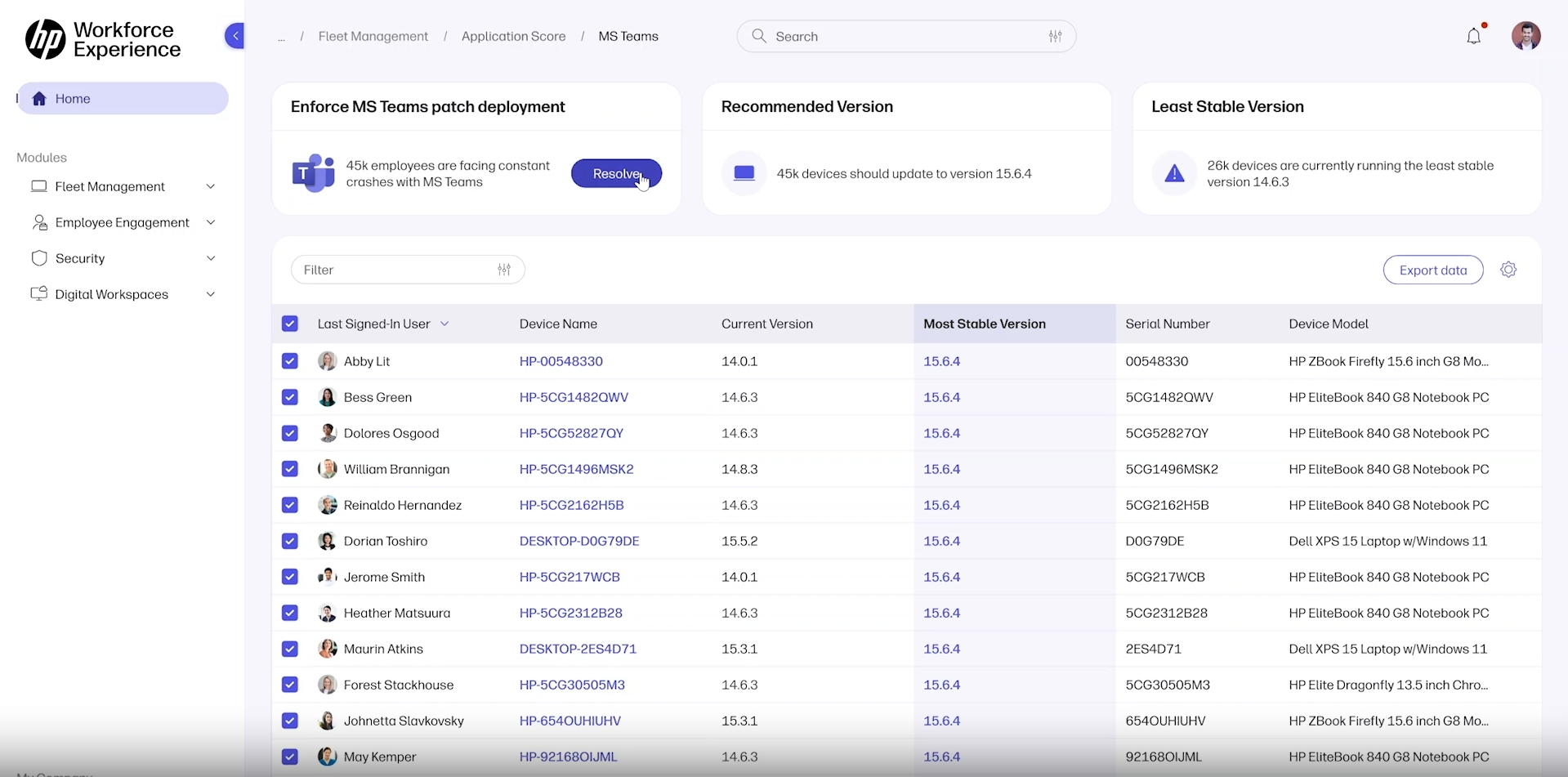
The HP Workforce Experience Platform (WXP) monitors the current and stable versions of applications on employee devices and enables IT teams to deploy patches in a single click. Here, an update for Microsoft Teams is being deployed to various device models using unstable versions of the application.
Tool #3: Endpoint security monitoring software
Endpoint security monitoring is crucial to maintaining the health of employee devices, particularly in today’s threat landscape. The global cybercrime economy, valued at $9.5 trillion, ranks as the world’s third-largest economy by GDP according to Bloomberg. Implementing robust endpoint security monitoring tools can help organizations protect their devices and data from cyber threats.
"Modern endpoint security products have evolved from point products to multifunction platforms that entail more than EPP (Endpoint Protection Platform) and EDR (Endpoint Detection and Response) functions to include additional capabilities in prevention and postattack recovery."
Michael Suby
Research Vice President, Security and Trust @ IDCSource: Yahoo Finance
Organizations can detect and respond to threats more effectively by adopting advanced endpoint security monitoring tools. These tools provide comprehensive protection, ensuring that all devices remain secure and operational within a fleet.
In conclusion, device health monitoring tools are essential for maintaining the performance and security of an organization’s IT infrastructure. By implementing effective device monitoring and management, application and OS health monitoring, and endpoint security monitoring tools, organizations can optimize the digital employee experience, reduce downtime, and protect against cyber threats. Investing in these tools is a strategic move that can lead to significant long-term benefits for employees and the organization.