Digital Employee Experience (DEX) software helps organizations monitor, manage, and optimize the digital workplace by enhancing device performance, application usability, and employee productivity. With the increasing complexity of IT environments, businesses need platforms that offer a comprehensive view of employee device performance within fleets and tools for improving it. This article highlights key considerations for selecting DEX management software that offers these solutions, drawing insights from industry experts to help in the evaluation process.
DEX Software Consideration #1: Proactive issue resolution
Many organizations struggle to deliver essential IT services, leading to inefficiencies and frustration. According to a survey by the IBM Institute for Business Value, only 47% of tech leaders believe their IT organization effectively delivers basic technology services. This gap highlights the urgent need for intelligent, automated solutions that resolve issues quickly and prevent them from occurring in the first place. As a result, proactive and automated issue resolution has become a top priority for IT decision-makers (ITDMs) to minimize disruptions, maintain productivity, and reduce downtime.
"ITDMs prioritize solutions that deliver proactive issue resolution to minimize disruptions, reduce mean time to resolution (MTTR) for faster recovery, and seamlessly integrate across their tech stack. Configurability, automation, and AI-driven insights that enhance employee productivity and satisfaction are also key differentiators."
Kristin Kent
Director of Product @ HP
By leveraging proactive and automated issue resolution, businesses can improve their IT service delivery and enhance employee satisfaction. This approach addresses potential problems quickly, reducing the impact on daily operations and allowing IT teams to focus on strategic initiatives.
DEX Software Consideration #2: A holistic view of endpoints
The average U.S. enterprise runs about 135,000 endpoint devices, half of which can’t be detected by IT departments or are running on outdated operating system software, according to Cybersecurity Dive. Because of this, organizations need comprehensive DEX management software and tools to provide visibility and control over all digital assets.
"Integrating SaaS management into traditional IT asset frameworks means incorporating the oversight, control, and operational processes of cloud-based software services into the established systems and practices used to manage on-premises software and hardware assets. This integration aims to create a unified approach to managing all IT resources, regardless of whether they are hosted internally or provided as a service by external vendors."
Matt Verlaque
COO of SaaS Academy; previously co-founder of High-Speed VenturesSource: The ITAM Review
By adopting a complete, unified platform to manage the hardware and software running in an employee device fleet, IT teams can drastically improve operational efficiency and reduce the risks associated with unmanaged or outdated devices. This holistic view of IT assets enables better decision-making and resource allocation.
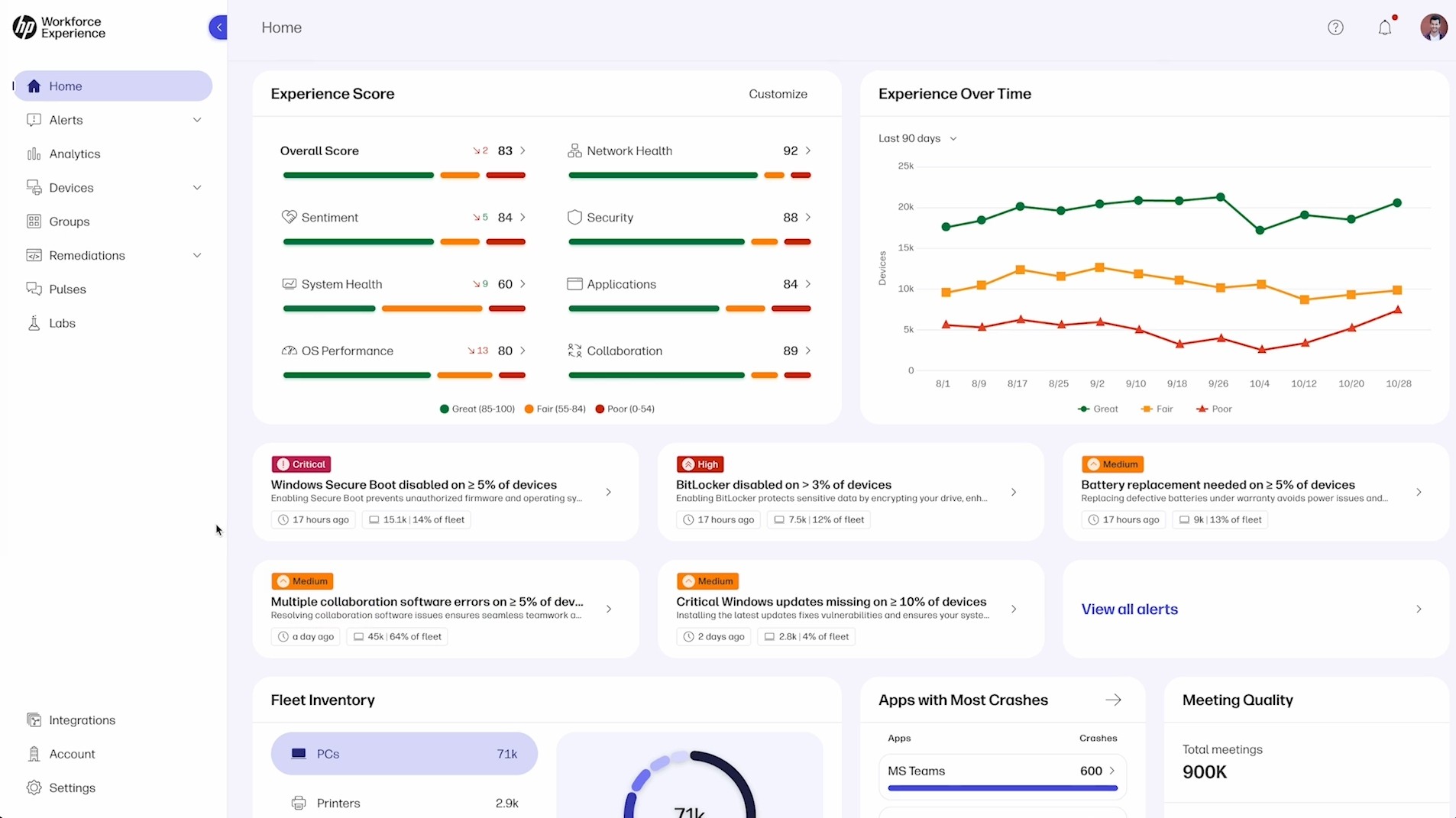
The HP Workforce Experience Platform (WXP) offers a holistic view of the digital employee experience and gives IT teams the ability to manage all employee endpoints from a single pane of glass.
DEX Software Consideration #3: Seamless integrations
When evaluating DEX management software, the platform’s compatibility with the tools in your existing IT infrastructure (e.g. Microsoft Intune) needs to be considered. Without seamless integration, even the most advanced solutions can create silos, increase complexity, and hinder productivity. At the Gartner IT Symposium/Xpo 2024 in Barcelona, experts revealed that only 48% of digital initiatives achieve or surpass their intended business outcomes. These survey results underscore the importance of choosing solutions that work effortlessly with current systems and workflows.
"Data and API orchestration are critical to optimizing the digital employee experience. Ensuring a services layer that seamlessly connects and coordinates APIs into a single, coherent system can help deliver visibility and control over various functions while providing the flexibility and extensibility organizations need as they scale."
Faisal Masud
President of Worldwide Digital Services @ HPSource: Forbes
By focusing on seamless integration, businesses can maximize the value of their existing investments while ensuring that new solutions enhance rather than disrupt their operations. This approach allows for greater agility and scalability, enabling organizations to adapt to changing needs and priorities.
In conclusion, the best DEX management software 1) supports a proactive IT strategy, 2) provides a holistic view of endpoints from a single pane of glass, and 3) integrates seamlessly with existing endpoint management software. With such a solution, organizations can streamline IT operations, reduce disruptions, and improve employee satisfaction.