
Top EUEM Tools
IT experts share insights about improving the technology experience for employees with end user experience monitoring (EUEM) tools.

Larry Meadows
Head of WXP Product Strategy & Evangelism
IT teams add end user experience monitoring (EUEM) tools to their tech stack to measure the performance of devices, applications, and networks used by employees in the fleets they manage.
The best approach for measuring end user experiences is blending telemetry with human context. Three types of end user experience monitoring software enable IT teams to do this:
- digital employee experience (DEX) software for monitoring device and application performance,
- digital experience monitoring (DEM) software for monitoring network performance,
- and pulse surveys for monitoring employee sentiment about the technology they use.
DEX software for monitoring end user devices
DEX software turns raw endpoint telemetry into insights that IT teams use to identify device and application issues actively affecting employees or likely to affect them in the future. This dual approach to end user experience monitoring supports traditional helpdesk tasks as well as proactive IT.
According to a Forrester survey of 300+ IT professionals, 65% see fewer disruptions to the end user experience as a result of current DEX practices.
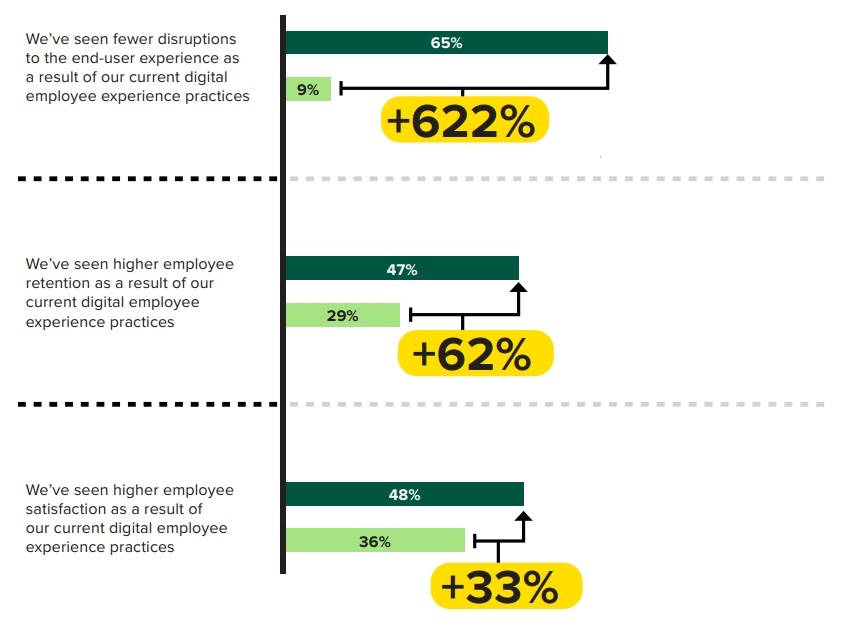
IT teams that use end user experience monitoring tools like DEX software report fewer disruptions to employee work and higher employee retention.
A common challenge in IT environments is prioritizing issues based on real impact rather than surface-level data. Traditional monitoring might flag an audio driver with 200,000 crashes a month as a top issue. However, deeper insights could show it affects only 500 users and needs a simple update. Meanwhile, a collaboration tool with fewer crashes may impact 4,000 virtual employees, making it a more urgent priority. Modern DEX software is crucial because it helps IT teams prioritize fixes based on actual impact and allocate support desk resources optimally.
Larry Meadows Head of WXP Product Strategy & Evangelism Source: Driving an "End-to-End" Employee Experience (WXP Blog)
Action step: As part of your end user experience monitoring strategy, review top considerations for DEX software. At a minimum, digital employee experience tools and software should provide proactive issue resolution, a holistic view of endpoints (i.e. monitoring and telemetry), and integrations with other IT software in your tech stack.
DEM software for monitoring end user networks
When performance issues involve VPNs, ISPs, and Wi-Fi, network-aware telemetry is the fastest path to the root cause. Digital experience monitoring (DEM) tools combine synthetic tests, real user monitoring (RUM), and path analytics to isolate whether the fault sits on the device, LAN/WAN, or SASE stack.
According to Gartner, at least 60% of IT leaders will use DEM software by 2026 to measure application, services, and device performance from the end user’s perspective, up from less than 20% in 2021.
“Why can’t the CEO reach SharePoint while traveling abroad? Could it have been poor Wi-Fi signal strength in the hotel? Or something else entirely? Without the proper tools, it’s nearly impossible to answer these questions. With Digital Experience Monitoring, [you have] the tools you need to quickly find the needle in the haystack and resolve issues related to performance and connectivity.”
Abe Carryl
Product @ CloudflareSource: Introducing Digital Experience Monitoring (Cloudflare Blog)
Action step: To start monitoring network health across your fleet using real-time and historical end user monitoring metrics, research digital experience monitoring tools such as Dynatrace, Datadog, and ThousandEyes. Gartner provides a comprehensive list of top providers based on customer reviews.
Pulse surveys for monitoring end user sentiment
According to research from Forrester, 58% of employees would rather live with unresolved technical issues than contact the service desk. Pulse surveys close the gap between what telemetry-based software shows and how employees actually feel about the technology they use.
Qualitative data enables IT to not only conduct more proactive tech repairs but also boost productivity so the workforce can get the biggest bang for their buck from the tools they use. Turnkey pulse surveys can provide contextual intelligence that CIOs are often missing and empower businesses to take a more data-driven, strategic approach to improving the employee experience.
Faisal Masud President of Worldwide Digital Services Source: Architecting a World-Class Digital Employee Experience (WXP Blog)
Action step: Measure employee sentiment with targeted surveys and qualitative analysis to identify the technology issues that device and network telemetry miss.
Watch Naavica Adunur demo the Pulses module in WXP. Use this feature to send surveys to employees and measure employee sentiment.
Key takeaways for end user experience monitoring tools
- Use DEX to focus on real impact. Digital employee experience platforms translate raw device and app telemetry into insights that IT can use to prioritize issues based on who is affected and how severely.
- Strengthen visibility with network-aware DEM. Digital experience monitoring tools extend monitoring beyond the endpoint to include Wi‑Fi, VPN, ISP, SASE, and cloud paths. By combining synthetic tests with real user data, IT can isolate the true source of connectivity and application slowdowns.
- Add human context through pulse surveys. Telemetry shows what is happening, but surveys reveal how employees experience it. Short, targeted “pulse surveys” uncover hidden friction points and validate technical data.