Your WMS shows 50 units of a SKU on hand. The physical shelf has 10. That discrepancy may indicate an out-of-shelf condition, misplaced inventory, or a mismatch between the recorded and physical state. That discrepancy didn’t happen this morning; it built up over weeks of unrecorded shrinkage, miscans, and returns processed against the wrong location code.
Vision AI converts inventory auditing from a scheduled event into a near-real-time data stream. Fixed cameras and edge inference models compare visible shelf state against WMS records at configurable intervals, emitting discrepancy events within the system’s detection and processing latency to trigger associate workflows or automated flags.
This guide covers the full deployment stack for retail IT teams, including camera placement, edge inference architecture, privacy and security controls, data pipeline design, and WMS and ERP integration, plus a five-step pilot scoping framework aligned with HP Intelligent Operations methodology to deliver provable ROI before scaling.
Why retailers struggle with stock accuracy
Retail stock accuracy problems often stem from a primary root cause: inventory data ages faster than it is refreshed, and three compounding factors aggravate the discrepancy:
- Infrequent cycle counts. Most stores run full counts monthly and partial counts weekly for high-velocity categories. Between counts, every exception (a returned item shelved in the wrong location, a unit pulled for a customer and never purchased, a delivery short-shipment) goes unrecorded, and the WMS record drifts.
- Phantom inventory. Shrinkage from theft, damage, and vendor discrepancies removes units from the shelf without triggering a WMS transaction. The system continues to show those units as available, suppressing replenishment orders for items that are actually out of stock, resulting in stores losing sales on products the WMS believes are fully stocked.
- Inaccurate records affect downstream processes. This includes replenishment, demand forecasting, and fulfillment allocation. A 10% error rate in one zone can cascade into allocation errors across multiple channels, and the longer the interval between counts, the further the WMS state diverges from physical reality. Manual audits can’t close this because the rate of shelf change-out exceeds what any cycle-count cadence can track.
How vision AI detects and corrects inventory deltas
Vision AI converts shelf auditing into a continuous operational data stream by running object-detection models against camera feeds, identifying visible products and their shelf positions, and comparing those observations with the inventory system’s expected shelf state. Accuracy varies significantly by SKU similarity, occlusion, camera placement, lighting, model quality, and the evaluation metric.
Keep in mind: a camera observes visible shelf state; it cannot measure total on-hand store inventory across backrooms or hidden stock. Therefore, retailers should establish a baseline and measure precision, recall, and counting stock accuracy during the pilot.
Fixed cameras mounted to shelf edges, overhead ceiling arrays, or gondola endcaps scan SKU positions at configurable intervals, typically every few seconds in high-velocity zones and less frequently in stable categories. Object detection models classify each facing by SKU and estimate visible units, producing a shelf state snapshot the system compares against the expected WMS record.
The comparison generates one of three outputs:
- Match: detected count aligns with the expected shelf state within a configurable tolerance (no action required)
- Discrepancy: observed shelf state differs from the expected shelf state beyond the threshold (event emitted to the data pipeline)
- Unknown: model cannot classify the facing with sufficient confidence (flagged for manual verification)
Discrepancy events carry the SKU identifier, shelf location code, observed quantity, confidence score, and timestamp. They route through a message queue to the integration layer where Agentic AI workflows translate observations into action: notifying an associate, triggering a task, or raising an alert. Verified discrepancies can be fed into an inventory review process rather than making direct, unverified WMS edits.
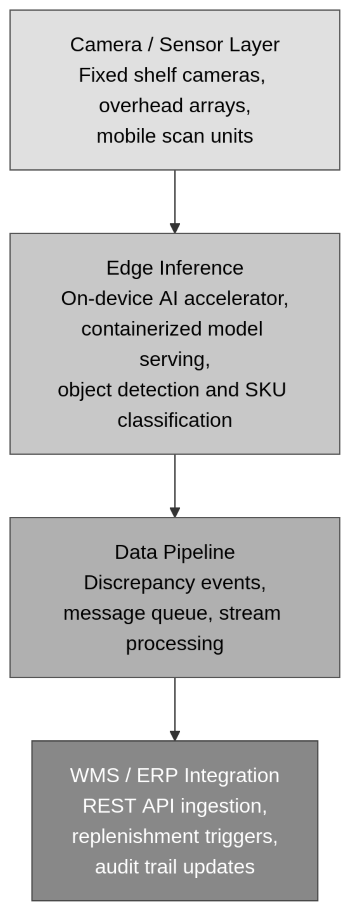
This four-layer pipeline connects cameras to WMS and ERP systems, with each stage handling a distinct part of the data flow from raw video to actionable inventory workflows.
Shelf intelligence, checkout validation, and loss prevention
Vision AI covers four well-established application areas in retail inventory management, all running on the same underlying pipeline described above.
Stockout and misplaced-item detection
Cameras identify empty shelf positions or products shelved in the wrong locations and generate alerts for associates to investigate and replenish. An empty shelf position indicates an on-shelf availability issue; it does not necessarily mean the store has no units remaining elsewhere. Detection runs continuously against the planogram layout on file, so the system flags a potential misplacement rapidly to prompt associate action rather than waiting for the next manual walk.
Planogram compliance
Object detection models compare actual shelf layout against the current planogram specification, covering facing count, product position, and shelf height. Deviations generate a compliance report or an associate task assignment, replacing periodic manual audits with a continuous, timestamped record of every deviation and resolution.
Checkout validation
A camera positioned over the checkout belt or self-checkout station cross-references items the system detected as placed against items the POS recorded as scanned. Misscans and unscanned items surface as real-time alerts, giving loss prevention teams actionable data before the transaction closes.
Loss prevention
Persistent monitoring of high-shrink aisles and checkout zones detects behavioral signals and operational anomalies associated with concealment and unpaid exits, including dwell-time anomalies, item handling without approaching the POS, and body-blocking. These signals serve as real-time indicators for loss-prevention staff to verify and intervene, providing operational context rather than definitive proof of intent.
IT infrastructure required to deploy vision AI in retail
A production vision AI deployment runs on an integrated foundation of hardware, software, and connectivity.
Camera and sensor layer
For a typical aisle deployment, camera selection should be based on the required pixel density at the shelf rather than megapixel count alone. Resolution, lens, mounting distance, lighting and SKU dimensions should be validated during the pilot. Overhead arrays cover wider zones but require higher resolution to resolve individual SKU facings. Fixed shelf cameras mounted at gondola height deliver the tightest field of view for planogram compliance work. Camera placement planning should center on sightline coverage, with each camera position requiring a clear line to its assigned shelf section, free of obstructions from signage, dividers, or product overhang.
Network layer
As a planning assumption, a 1080p H.264 stream may require a few Mbps per camera, but actual bandwidth should be sized from the camera’s configured bitrate and frame rate. Wi-Fi 6 access points handle moderate camera densities per zone. 5G private networks or wired Ethernet are common in large-footprint stores with high camera counts and challenging RF environments. Network segmentation and zero-trust security are critical requirements; vision AI traffic should run on a dedicated VLAN isolated from POS transaction traffic and guest Wi-Fi networks.
Edge inference
Edge inference processes video locally at the store, substantially reducing bandwidth requirements, lowering latency, and keeping sensitive video data strictly on-premises to satisfy privacy and compliance standards. The choice of AI accelerator hardware determines what workloads are achievable on edge endpoints deployed on the floor.
Privacy, security, and edge data governance
Deploying computer vision in retail environments requires strict privacy and data governance controls. By executing inference locally at the edge, raw video feeds remain within the physical site boundaries rather than streaming to the cloud. Edge models perform feature extraction and object classification locally, emitting only anonymous structured metadata (such as SKU counts and bounding box coordinates) to backend enterprise systems. Standard security protocols include blurring or anonymizing facial features at the edge runtime, enforcing encrypted transit via TLS for metadata streams, and maintaining compliance with regional privacy frameworks (such as GDPR or CCPA).
The HP AI Accelerator M.2 Card, powered by the Hailo-10H, is a concrete example of retail-grade edge AI hardware designed for this role. It delivers 40 TOPS of INT4 performance while drawing less than 8.25W, and installs directly into the M.2 2280 (Key M) slot on HP Engage One Pro G2, HP Engage Flex Pro G2, and HP Engage Flex Mini G2 systems, with no separate inference server required for most store workloads.
The card supports simultaneous execution of multiple models, which is practical when a single endpoint needs to run planogram compliance scanning and checkout validation streams concurrently. Models compiled for the Hailo-10H from TensorFlow, PyTorch, or ONNX run via Hailo’s toolchain, with support for standard architectures including YOLO and ResNet variants.
Software and integration
Model serving runs inside a containerized runtime on the endpoint, with an Edge AI management software layer handling workload deployment, security isolation, model versioning, drift monitoring, and fleet-wide remote updates. Vision AI outputs connect to WMS and ERP systems via REST endpoints or message queues (MQTT/AMQP). Discrepancy events carry at minimum a SKU identifier, shelf location code, observed quantity, confidence score, and ISO 8601 timestamp. The WMS API endpoints and accepted message formats determine the data structure the vision AI pipeline must produce, which is why the integration schema needs to be designed before hardware procurement.
How to scope a vision AI pilot
Many vision AI pilots stall in “pilot purgatory” because infrastructure constraints or unclear business objectives surface after hardware arrives. HP’s recommended methodology inverts that sequence by starting with one clear outcome, one site, and one metric on a foundational architecture that can easily scale across multiple AI workloads without technical dead ends.
-
Select one high-shrinkage zone. Choose a zone with documented shrinkage data. Beer and spirits, cosmetics, and consumer electronics accessories are common high-velocity, high-loss categories. Limit initial scope to 20–30 linear feet of shelf facing, small enough to instrument fully and large enough to produce statistically meaningful stock accuracy data.
-
Document baseline operational KPIs. Pull historical cycle count results and operational metrics for the target zone. Beyond stock accuracy rates, record secondary benchmarks such as labor hours spent on manual audits, out-of-stock duration, or associate task response times. Capturing a multi-faceted baseline ensures you can prove broad ROI across labor productivity and stock performance.
-
Audit camera coverage and network capacity. Map existing camera positions against the zone. Identify coverage shortfalls and resolution deficits. Check available bandwidth on the store VLAN and confirm whether an M.2 slot is available in the endpoint serving the target zone. If it isn’t, factor a new endpoint or a PCIe-based alternative into the hardware estimate before the pilot budget is set.
-
Map WMS API endpoints for discrepancy ingestion. Identify the API endpoints and workflows used to ingest inventory observations, discrepancy events, replenishment requests, and, where appropriate, verified quantity corrections for the zone’s location codes. Document the authentication model (OAuth2, API key, or certificate-based), rate limits, and accepted payload format. This step frequently surfaces undocumented dependencies, such as WMS integrations configured for batch updates that need modification to accept event-driven quantity corrections.
-
Define a 30-day or 90-day checkpoint. Set the measurement methodology before deployment starts. Agree on a recount method, sampling frequency, associate response workflows, and target success metrics. Establishing these checkpoints in advance prevents goalpost shifting and prepares a clear business case for fleet rollout.
Completing this framework before any vendor conversations surfaces the technical constraints that determine the actual deployment cost and timeline, which is one of the most productive actions to take at this stage of evaluation.
Frequently asked questions
What is vision AI in retail inventory management?
Vision AI in retail inventory management refers to camera-based computer vision systems that continuously classify shelf states (SKU presence, facing count, planogram position) and compare detected conditions against inventory records without manual audits. These systems emit a continuous stream of shelf-state observations and discrepancy events that can feed WMS and ERP workflows in near real time. Rather than replacing physical counts entirely, they provide more frequent visibility into shelf conditions and help prioritize verification and replenishment tasks.
What IT infrastructure does vision AI require in a retail environment?
A production deployment requires four layers, starting with edge-capable endpoints with AI accelerator hardware for on-device inference. Those endpoints connect through high-bandwidth, low-latency networking (Wi-Fi 6 or 5G) with VLAN segmentation for security. Containerized model serving software with an MLOps pipeline handles version management and drift monitoring, and REST or message-queue APIs connect vision AI outputs to WMS and ERP systems.
What is the difference between edge and cloud processing for retail vision AI?
Edge inference handles the latency-sensitive work (classifying shelf states, detecting discrepancies, generating alerts) at the store in near real time. Cloud processing handles compute-intensive, non-latency-sensitive work including model training on new SKU data, cross-store analytics, and fleet management across deployed endpoints. Most production deployments use both, with edge handling operational alerting and cloud handling model improvement and reporting.
How does vision AI integrate with an existing WMS?
Vision AI outputs connect to WMS systems via REST API endpoints or a message queue, with MQTT and AMQP both common in retail edge environments. Discrepancy events carry a SKU identifier, shelf location code, detected quantity, confidence score, and ISO 8601 timestamp. The WMS API’s accepted message format and authentication model (OAuth2, API key, or certificate-based) determine the exact payload structure the vision AI pipeline must produce, so mapping those endpoints before hardware procurement prevents costly rework.
How long does a vision AI pilot typically take to show results?
A well-scoped pilot covering 20–30 linear feet of shelf facing in a single high-shrinkage zone can produce statistically meaningful accuracy data within 30 days, provided the baseline KPI is documented before deployment starts. The 30-day window is long enough to capture multiple replenishment cycles and enough discrepancy events to validate model performance, but short enough to keep the pilot budget contained before a broader rollout decision.
Can vision AI systems handle low-light or variable lighting conditions in stores?
Shelf cameras rated for retail deployment include IR capability to maintain classification accuracy in low-light conditions, such as overnight restocking periods or dimmed promotional lighting zones. Model performance in variable lighting depends on training data diversity, so models trained on images captured across the full range of a store’s lighting conditions outperform those trained only on standard daytime footage.
What causes vision AI models to drift over time in a retail environment?
Model drift in retail vision AI typically stems from SKU packaging changes, new product introductions, seasonal planogram resets, and shifts in ambient lighting during store renovations. An MLOps pipeline with scheduled retraining and drift monitoring detects these changes before classification accuracy degrades enough to compromise the reliability of discrepancy events. Retraining frequency should be calibrated to the rate of SKU turnover in the monitored zones.
Start with one zone, one metric, and one clear baseline
The scoping framework in this guide exists because the most common reason vision AI pilots stall is that infrastructure constraints and operational workflows are overlooked until hardware arrives. Running the framework first (auditing camera coverage, mapping WMS API endpoints, establishing privacy boundaries, and documenting a baseline KPI) converts potential surprises into clear, actionable requirements.
A single high-shrinkage zone, fully instrumented and measured against a documented baseline, gives you the data you need to justify a broader rollout or identify the specific layer (camera density, network capacity, integration schema) that needs work before you scale. That’s a more useful outcome from a 30-day pilot than a proof of concept that looks good in a demo but can’t connect to your WMS in production.
If you want to eliminate the operational blind spot in your physical stores, HP provides an end-to-end path from a single high-impact pilot to an enterprise scale deployment, backed by HP forward-deployed engineering support. With this approach you can choose one site, one use case, and one metric to prove value in 90 days without technology dead ends.