How DEX Changes the Calculus of Human Capital Investments

Digital employee experience (DEX) management can help organizations turn workforce investment into stronger business performance.
Gone are the days when an employee’s career journey began with a handshake, a desk visit, or a face-to-face meeting. Today, much of the employee lifecycle has gone virtual, with nearly 80% of interactions happening through company systems rather than in person at a single physical location.
But when technology holds employees back, organizations get less value from their workforce investments. Understanding whether employees are set up for success is also becoming more complex.
- Do new hires have the tools, access, and support they need?
- Can HR and IT see where digital friction appears?
- Is onboarding being tailored to the needs of different employees, such as recent graduates vs. seasoned executives?
Beyond onboarding, HR leaders need better ways to support employees throughout the employee lifecycle, across different roles, skill sets, and backgrounds. They need data to measure and understand whether digital experiences improve productivity, engagement, and retention.
That requires organizations to change how they support employees and measure the return on their workforce investments.
HR Needs a New Playbook
One of the key priorities for CPOs and HR leaders is to create environments that maximize employee potential. Yet according to HP research:
- Only 60% of knowledge workers believe they’re given the tools to be successful at work.
- 65% experience device issues or failures each week.
- 20% experience meeting disruptions due to IT problems.
- 6% suffer from severe technical disruptions lasting 1 to 2 hours each week.
- Just 29% have a healthy relationship with work.
For people organizations, these persistent issues present an opportunity to rethink how technology supports employees. Compensation, benefits, and culture may get employees in the door, but all else being equal, the digital experience can determine whether they feel equipped to stay, grow, and do their best work.
Digital employee experience (DEX) management software helps IT organizations monitor, manage, and improve digital employee experiences across devices and applications. It can proactively identify and fix issues before they impact users and boost engagement with employee sentiment surveys.
Research from MIT finds that companies in the top 25% for employee experience have greater business value, higher customer satisfaction, greater agility, and greater profitability. For HR, DEX is fast becoming an indispensable tool for turning talent investment into stronger business performance.
The New Economics of Talent Investment
Small DEX improvements can have a big economic impact when applied across the entire workforce. For example, an enterprise may have 1,000 full-time employees that work a standard 2,000-hour work year.
If DEX management saves each employee just 15 minutes per day, the organization recovers 62,500 hours annually.
DEX can also reduce human capital costs by:
- Accelerating onboarding
- Giving employees the right devices, software, and tools
- Reducing IT support tickets
- Simplifying routine HR tasks
- Streamlining training
- Optimizing workspace enablement
- Reducing costs tied to attrition and replacement hiring
In a time when AI productivity gains and ROI remain difficult to prove, DEX delivers tangible outcomes that organizations can actually see and measure.
Increasing human capital return on investment (HCROI)
HCROI measures a company’s operating profit relative to its investment in employees. An HCROI of 1.5 means the company generates $0.50 in operating profit for every $1 spent on human capital costs.
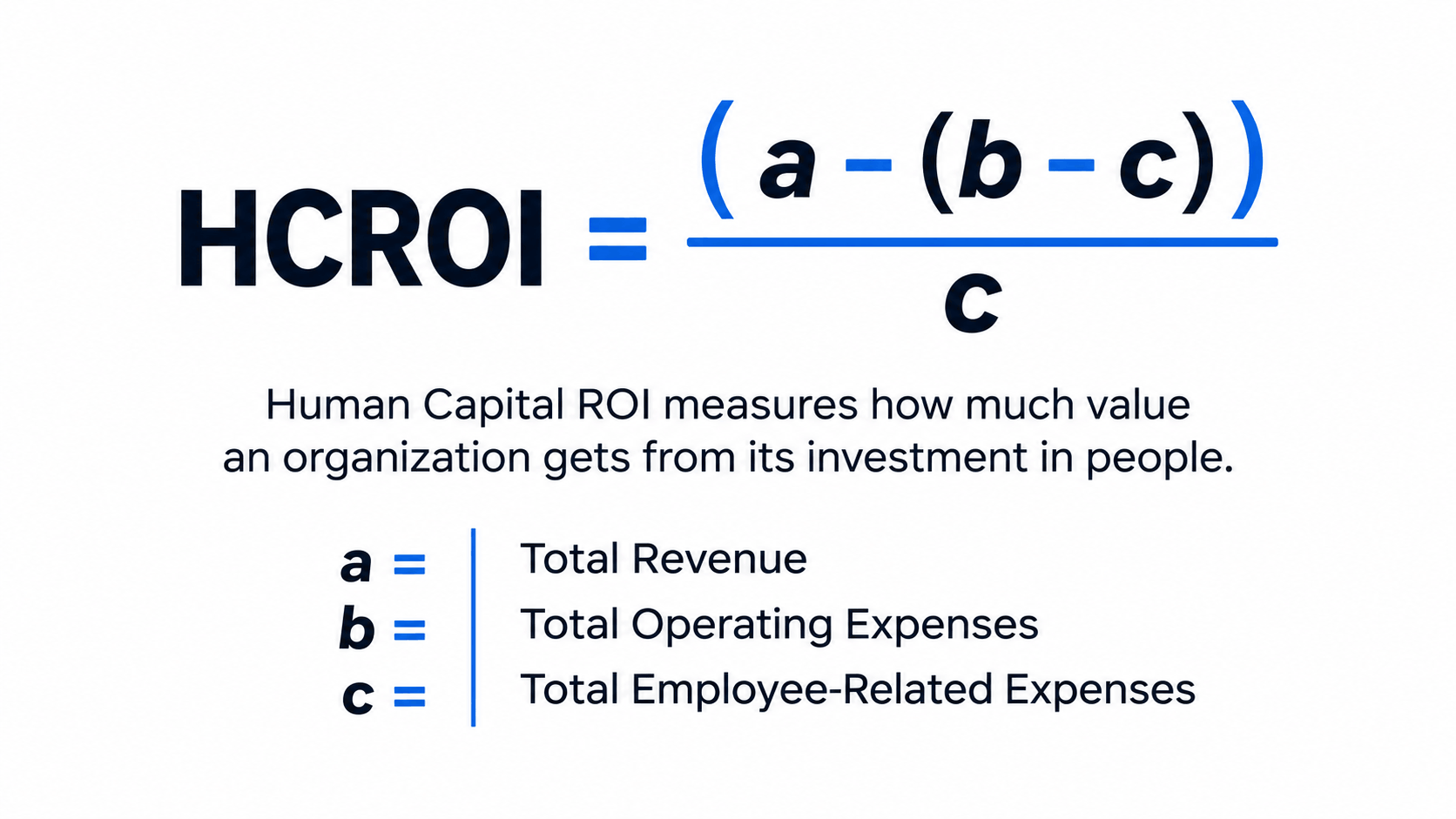
DEX software can alter the numerator and denominator of the HCROI equation by lowering employee costs, helping organizations generate more value per dollar of talent investment.
In the earlier example, let’s assume the company generates $200 million in revenue with $170 million in total operating expenses, including $100 million in employee costs. Its HCROI is 1.30.
If DEX management helps reduce employee costs by $1 million, total operating expenses fall to $169 million, including $99 million in employee costs. HCROI increases to 1.31, or $0.31 in operating profit for every $1 spent on employees.
Building the Future of Work With Better Experiences
Teams need reliable technology that helps them collaborate and perform at their best wherever work happens. Intentionally designing digital experiences around employees and the technology they use is essential to future-ready work.
Here at HP, we’re delivering a unified DEX ecosystem to help organizations remove friction across the entire digital journey. The HP Workforce Experience Platform (WXP) is an AI-powered SaaS solution that enables IT to monitor and manage all of a company’s technology in one place. It provides end-to-end visibility across devices, applications, printers, collaboration tools, and virtual environments, enabling IT to anticipate and resolve issues before they disrupt employees.
DEX is now a business imperative for CPOs and HR leaders. By helping employees perform at their best, organizations can achieve greater gains in productivity, retention, and HCROI.
HP Workforce ExperienceTM Platform is a comprehensive digital employee experience solution that enables organizations to optimize IT for every employee’s needs.
Discover how it can transform your IT operations from a cost center to a business accelerator. Simply fill out the form below, and our team will be in touch soon.
From the blog
The latest industry news, interviews, technologies, and resources.





Frequently asked questions
Here's everything you need to know about WXP.
- What is the HP Workforce Experience Platform (WXP)?
- How does WXP work?
- Can WXP be customized to fit specific business needs?
- How is WXP modular?
- Is WXP compatible with different vendors and operating systems?
- How does WXP integrate with other IT tools to provide a more comprehensive solution?
- What is a Workforce Experience score?
- How is AI used within WXP?
- How can I buy WXP and find out about new releases?