
A modern store generates sensor events continuously, ranging from RFID reads, barcode scans, and weight scale deltas to camera frames and transaction completions. Some workloads also rely on the cloud or a data center for processing before anything happens in-store. For long-horizon analytics, that architecture works fine. For workloads that require sub-second response times or can’t tolerate WAN downtime, it doesn’t.
Edge computing moves selected workloads to hardware at or near the point of collection. The store handles what it needs locally while cloud systems own coordination, long-range analytics, and workloads that benefit from centralized compute, making the two architectures complementary.
The three edge computing use cases in retail below cover where this shift has the most practical impact on inventory management, loss prevention, and AI which 91% of retail IT leaders identify as a top technology priority in 2026 according to Gartner. In this article, we’ll look at the underlying architecture that ties all three use cases together, what’s available to deploy today, and where the industry is heading next.
Why edge changes the calculus for retail AI
Three infrastructure realities drive the move toward edge processing in retail: sensor volumes, WAN dependency, and inference latency. Each creates conditions where local processing outperforms a cloud-round-trip model.
For example, a mid-size grocery store can generate a high volume of RFID events as tagged inventory moves through receiving, storage, and sales areas. A self-checkout lane processes barcode scans, weight confirmations, and payment signals in parallel. Sending every raw event to a cloud backend for real-time decision-making creates both latency and cost at scale.
Stores also operate in environments where internet connectivity is intermittent, not frequently, but predictably. A loss prevention system that requires cloud connectivity to flag an unscanned item, or an inventory system that can’t trigger a replenishment alert during a brief outage, introduces a WAN dependency that local processing can remove for the affected workload.
Running a trained model in the cloud means a round-trip before any decision is made. For workloads where the decision needs to happen in under a second (e.g., flagging a weight-to-scan mismatch at checkout), relying on a WAN round trip introduces additional latency and a connectivity dependency that local processing can avoid.
The architectural foundation across all three use cases is a modern edge computing platform capable of processing sensor data locally while synchronizing with centralized cloud services. In retail environments, these platforms often combine local compute resources, sensor integration frameworks such as EdgeX Foundry, and centralized fleet management tools.
EdgeX Foundry is an open source, vendor-neutral microservice framework built for the network edge. It provides a sensor- and cloud-agnostic ingestion model in which device services handle protocol-specific communication with physical sensors, a message bus routes normalized events internally, and application services apply business logic to those events locally before anything leaves the store. Independent software vendors can build on top of this stack without writing custom hardware integration code for every sensor protocol.
Use case #1: Real-time inventory monitoring and replenishment
Real-time inventory monitoring and replenishment is one of the primary edge computing use cases in retail. Edge infrastructure shortens the inventory feedback loop by running replenishment logic locally on sensor data, so a shelf can trigger an alert within seconds rather than waiting for a cloud round trip or an end-of-day reconciliation cycle.
Inventory accuracy is a persistent operational challenge in retail. Stock-level discrepancies accumulate from receiving errors, theft, miscounts, and sensor latency. Traditional approaches (periodic cycle counts, end-of-day reconciliation) are slow. Delaying inventory events before they reach a system capable of acting on them can extend the time between a stock-level change and a replenishment response.
RFID-enabled inventory systems have become a major factor in addressing the inventory problem. NRF notes that RFID technology can help retailers achieve inventory tracking accuracy rates of up to 99% while reducing stockouts and compressing cycle counts. However, the problem remains of syncing RFID with other retail systems.
Enter: EdgeX Foundry.
In a retail edge architecture, RFID readers, barcode scanners, and weight scales can connect through EdgeX Foundry device services or similar edge integration frameworks. Each device speaks its native protocol, whether that’s Modbus for industrial sensors, MQTT for connected shelf hardware, BLE for portable scanners, or REST for networked devices. Device services normalize the raw protocol data into a common event format and publish it to the EdgeX message bus. Application services running locally on the edge device then evaluate those events against configurable business rules. For example, if a weight sensor detects an empty shelf zone and an RFID reader hasn’t logged a replenishment scan in the last window, the system triggers a replenishment alert without waiting for a cloud round-trip.
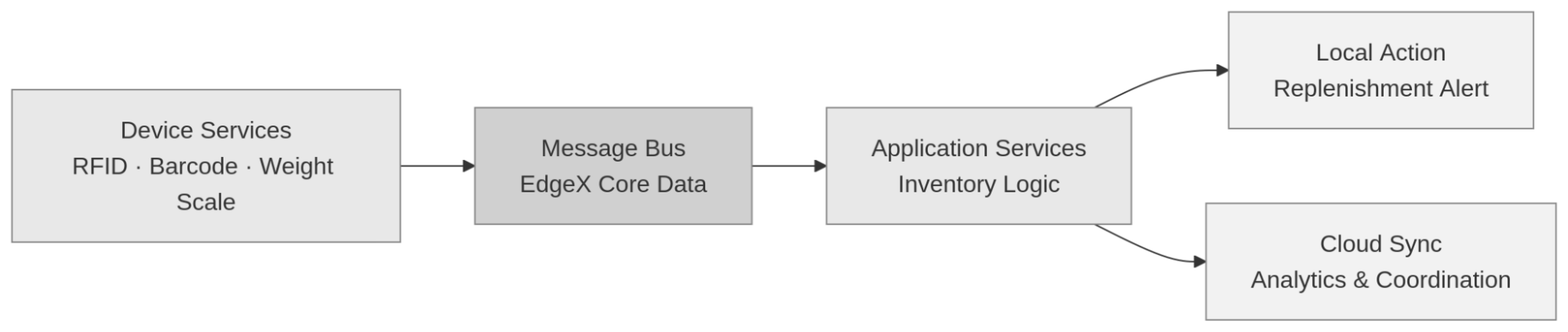
In a retail edge architecture using EdgeX, device services normalize raw protocol data into a common event format that application services can evaluate and act on.
Centralized systems still play a role. Historical inventory analytics, cross-store coordination, demand forecasting, and catalog synchronization all benefit from cloud processing. Time-sensitive replenishment logic belongs at the edge, while trend analysis belongs in the cloud.
For engineering teams managing distributed store fleets, HP Workforce Experience™ Platform (WXP) adds the operational layer. WXP provides fleet telemetry, device health monitoring, and predictive maintenance across store endpoints, helping IT teams identify device issues before they affect store operations. That visibility becomes critical once edge workloads are running at scale across hundreds of locations. This infrastructure pattern is available today through modern edge computing platforms combined with centralized fleet management capabilities such as WXP.
Use case #2: Loss prevention
Edge-based loss prevention correlates signals from barcode scanners, weight scales, and transaction logs locally, catching checkout anomalies without waiting for a cloud round trip.
Loss prevention generates some of the most diverse signal types in the store, including camera frames, barcode scan sequences, weight sensor readings, and transaction logs. The challenge is to correlate multiple signals in near real time to detect anomalies that no single sensor would catch on its own. Two distinct approaches apply at the edge, and understanding where the industry is headed gives engineering teams the context they need for planning.
Edge infrastructure can process checkout-lane signals from barcode scanners and weight scales together to identify rule-based mismatches. An item placed in the bagging area that doesn’t match the last scan, a weight reading that exceeds the sum of scanned items, or a transaction completed without a scan event for a logged item are all detectable through deterministic logic checks. These checks require correlated sensor events evaluated locally in milliseconds, with no computer vision or trained ML model involved. A local edge computing platform running application services via EdgeX Foundry or comparable software provides the local compute and sensor ingestion to execute these checks at the lane without a cloud dependency.
Processing locally also limits what leaves the store. A sensor-correlation system that flags a mismatch doesn’t need to transmit raw video to a backend to make that call. Only the alert and relevant metadata need to travel, which reduces both network bandwidth and the data surface exposed in transit.
Behavioral detection, camera-based checkout validation, and aisle monitoring via computer vision require trained models, higher compute headroom, and more sophisticated data pipelines. The retail industry is actively building toward this architecture, and many retail edge platforms are evolving to support these capabilities as computer vision deployments mature.
Start with sensor-rule-based edge logic to achieve immediate operational gains, and design the infrastructure to support on-device inference in the next phase.
Use case #3: In-store AI for customer experience
On-device inference runs a trained model’s inference step directly on local hardware, so the model produces its output without sending data to a cloud endpoint. For retail customer experience workloads, that approach delivers concrete advantages: local inference can reduce network latency and bandwidth requirements, allow selected workloads to continue during WAN interruptions, and reduce the amount of raw data that needs to leave the store.
The hardware requirement that makes this practical is a dedicated AI accelerator. Standard x86 compute handles many edge workloads well, but inference on vision models or large personalization models stresses a CPU in ways that affect throughput and response time. An M.2-form-factor neural processing unit addresses this by running inference in parallel with the host CPU rather than competing for the same compute resources.
HP’s AI Accelerator M.2 Card, featuring Hailo-10H-class hardware, is one example of this approach. It’s compatible with a range of HP Engage endpoints with an available M.2 slot, including the HP Engage One Pro G2 and Engage Flex Pro G2, as well as other compatible commercial systems. The card enables real-time inference for voice and vision workloads at the edge without routing data to a cloud AI endpoint.
The specific applications built on this hardware foundation are still maturing. The retail industry is developing a range of on-device inference use cases, including shelf intelligence (detecting out-of-stocks or planogram compliance via camera), traffic and flow analytics (understanding store movement patterns), and personalized interaction at self-checkout. HP’s platform is positioned to support these workloads as they develop. What’s available today is the inference hardware and the edge compute platform to run it on.
Engineering teams evaluating this architecture should audit their current endpoint fleet for M.2 slot availability before any other step. That single hardware constraint determines whether your existing install base can support on-device inference without a full equipment refresh.
Evaluating edge infrastructure readiness for retail
Before committing to an edge AI workload, your team needs to answer four concrete questions. Each one maps to a decision gate that, if skipped, surfaces as a deployment blocker later.
1. Do your endpoint devices have available M.2 slots?
M.2 availability is one of the first hardware compatibility checks for deployments using the accelerator. An HP AI Accelerator M.2 Card can be installed in compatible HP Engage endpoints that have a free M.2 slot, but if your current fleet doesn’t, that’s a hardware procurement decision rather than a software one. Audit your endpoint inventory before scoping a deployment.
2. Do your sensors speak protocols EdgeX Foundry supports?
EdgeX Foundry’s device service catalog covers Modbus, MQTT, REST, and BLE, among others. If your RFID readers use Modbus or your connected shelves publish over MQTT, device service support is likely already there. If you’re running proprietary protocols, check the catalog before assuming compatibility.
3. How will you enroll and manage the fleet?
At a handful of stores, manual setup is manageable. At 50 or 200 stores, it isn’t. The HP Workforce Experience™ Platform (WXP) supports fleet enrollment, remote management, and telemetry monitoring across HP edge devices and devices from other hardware manufacturers. Establish your fleet management approach before deployment. Determine whether your organization handles self-deployment using WXP documentation and tooling, or prefers support-assisted onboarding.
4. How do on-device models get updated without disrupting store operations?
Edge AI introduces a model lifecycle management challenge that cloud AI sidesteps, specifically pushing updated model weights to devices in production without taking a lane offline or breaking a checkout flow. This is an operational process question, not a tooling question. Define the update cadence and rollback procedure before you push the first model.
Answering these four questions turns an edge AI evaluation from a high-level discussion into an engineering plan with clear prerequisites and decision gates.
Frequently asked questions
What is edge computing in retail?
Edge computing in retail means processing data on a local endpoint or on-premise server at or near the store, rather than routing it to a central cloud for every decision. A barcode scan’s weight-mismatch check runs on hardware inside the store rather than traveling to a data center and back. The practical results are lower latency, continued operation during WAN disruption, and local data residency for sensitive transaction and customer data.
What is on-device AI inference?
On-device AI inference means running a trained machine learning model’s inference step directly on local hardware (an NPU, AI accelerator card, or similar processor) without sending data to a cloud endpoint. The model processes input (a camera frame, a sensor reading) and produces output (a classification, an alert) entirely on-device. Running inference locally removes round-trip latency and the cloud connectivity dependency that would otherwise make real-time AI workloads impractical in store environments.
What are the biggest challenges of deploying edge AI in retail?
Four challenges come up consistently:
- Sensor protocol heterogeneity means a store environment mixes RFID, barcode, weight scale, and camera data, each with its own protocol, and normalizing that into a single ingestion pipeline requires a framework like EdgeX Foundry.
- Fleet management at scale means pushing configuration changes, model updates, and firmware patches to hundreds of stores without disrupting operations, which demands a purpose-built management layer like HP Workforce Experience™ Platform (WXP).
- Hardware capability deltas mean not every endpoint in an existing fleet has an available M.2 slot, or enough compute headroom for inference workloads, and identifying those deltas requires an audit before deployment.
- Model lifecycle management means on-device models need to be updated when accuracy drifts, and doing that in a running store environment requires a defined update and rollback process.
How does edge computing help with retail data privacy?
Processing sensitive customer and transaction data locally means it doesn’t need to travel over a network to a cloud endpoint for every operation. A checkout anomaly detected via sensor fusion at the edge generates an alert rather than a raw video clip uploaded to a backend system. That reduction in data egress can support data-minimization strategies and reduce unnecessary transfer of personal data, which may simplify some aspects of privacy and data-governance requirements. For many organizations, local data residency is a primary reason to pursue edge architecture.
How does EdgeX Foundry handle sensor protocol diversity in retail stores?
EdgeX Foundry uses a device service layer, in which each service handles a single protocol (Modbus, MQTT, BLE, REST) and normalizes raw sensor output into a common event format before publishing it to the internal message bus. Application services then consume those normalized events without needing to know which physical sensor or protocol produced them. That separation means you can add a new sensor type by deploying a new device service without rewriting your business logic layer.
What is the difference between deterministic sensor fusion and AI-based computer vision for loss prevention?
Deterministic sensor fusion applies rule-based logic to correlated signals from barcode scanners and weight scales, flagging mismatches such as a weight reading exceeding the sum of scanned items. No trained model is involved, and the checks run in milliseconds on standard edge compute. AI-based computer vision uses trained models to analyze camera frames for behavioral anomalies, which requires more compute headroom, an AI accelerator, and a more complex data pipeline.
How does WXP support edge AI deployments at scale?
WXP provides fleet telemetry, device health monitoring, and predictive maintenance across HP edge endpoints. In an edge AI deployment, WXP surfaces hardware issues (a failed RFID reader, a device approaching thermal limits) before they create operational blind spots. It also supports fleet enrollment and remote management, which makes the difference between a manageable rollout and an unscalable one once you’re operating across dozens or hundreds of store locations.
Leveraging HP for edge computing in retail
Edge computing helps retailers execute latency-sensitive workloads closer to where data is generated while maintaining centralized visibility and coordination through cloud platforms.
For retailers evaluating edge architectures, key considerations include local compute capacity, sensor integration, AI acceleration, fleet management, and lifecycle support. HP supports these requirements through solutions such as HP Workforce Experience™ Platform (WXP) for fleet visibility and management, HP AI Accelerator technologies for local inference workloads, and a portfolio of retail and commercial computing systems designed for edge deployment scenarios. Together, these technologies help retailers build scalable edge architectures that support inventory intelligence, loss prevention, and emerging AI-driven retail experiences.