
Making the Case for Simple DEX Management

The last thing organizations need is more complexity, cost, and headcount.
For an industry that’s all about simplifying the digital employee experience (DEX), actually managing it sure has become expensive and complicated.
Offerings that were purpose-built to remove friction, optimize resources, improve productivity, and lower costs now require a new corporate layer just to operate. From dedicated headcount and certifications to training and administrative overhead, it’s never been more difficult to stand up a solution and start reducing friction across the employee experience.
Now more than ever, I believe we need to drive greater ease and efficiency across the employee experience.
Costs are soaring, with Gartner forecasting worldwide IT spending to reach $6.15 trillion in 2026.
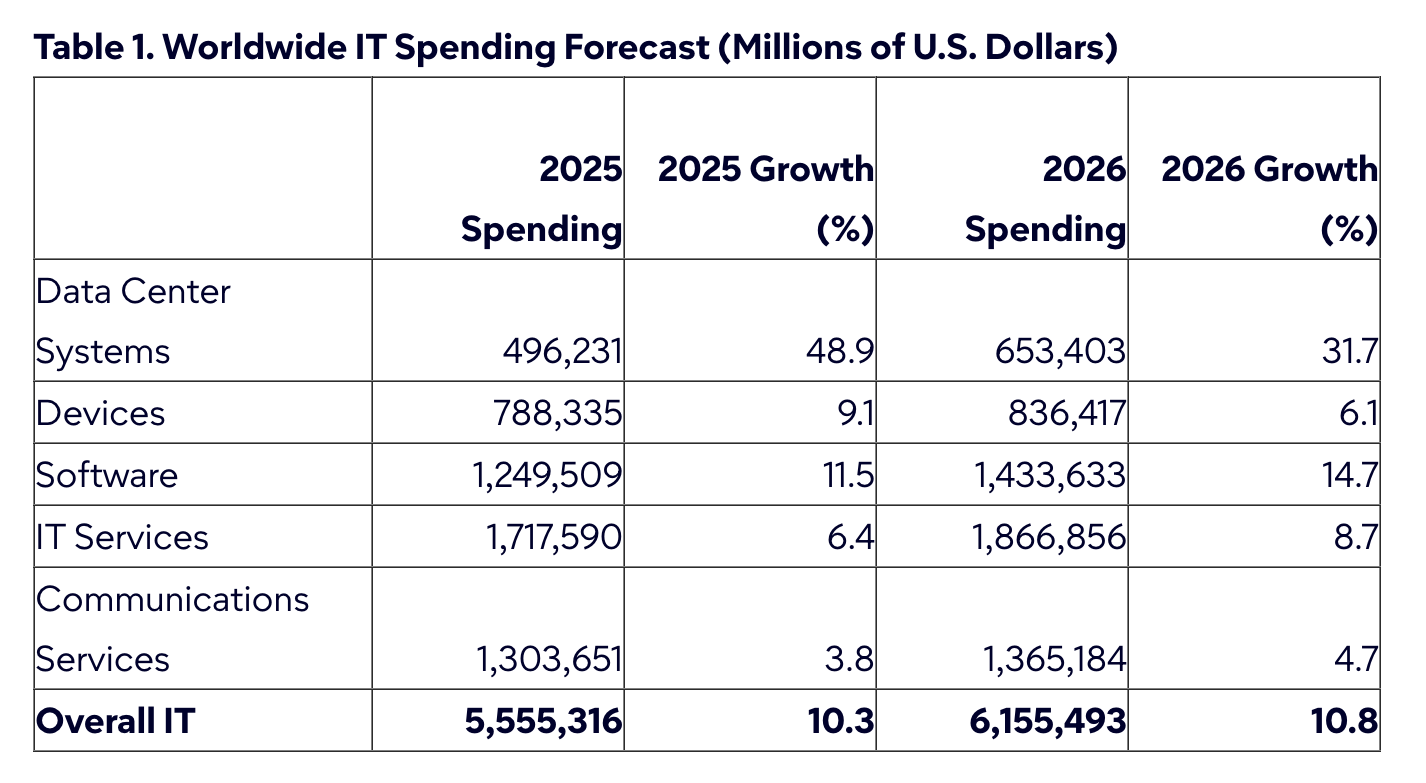
Source: Gartner
Meanwhile, pressure to do more with less is stretching IT teams thin, resulting in ticket backlogs, slower service delivery, and frustrated employees. Hybrid work has only made the problem worse, forcing teams to monitor and manage more issues across distributed devices and teams.
At this point, tacking on DEX management adds yet another system for IT to oversee. Unchecked, it can create a form of iatrogenesis, where the cure begins contributing to the disease.
Do DEX Vendors Know What Business They’re In?
In a highly commoditized business like DEX SaaS, there are only four logical paths for vendors to take in the long term:
- Become the low-cost producer.
- Leverage intangible assets like proprietary data, processes, etc.
- Build network effects across fleets, industries, and device populations.
- Increase switching costs.
The first three are especially difficult for non-OEM vendors. They don’t own the hardware relationship or have deep visibility into the device layer. Building these advantages also requires going beyond PCs to cover the full technology experience, including collaboration, print, space optimization, and retail intelligence.
That leaves increasing switching costs as the easiest path, where anyone can manufacture artificial barriers to create vendor lock-in. For example, some DEX platforms require “expert training,” forcing users to learn how to:
- Configure and manage the platform, user roles, data privacy, and integrations.
- Create and manage dashboards, alerts, campaigns, workflows, and remote actions.
- Measure and analyze application adoption, usage, sentiment, and performance.
- Use diagnostics and read/write specific query languages.
- Design and manage automation processes using workflows, APIs, and webhooks.
- Create and manage guidance and content.
- Measure and track platform performance, adoption, and impact.
With steep learning curves, new query languages, and high complexity, some DEX platforms have become almost impossible for untrained, non-technical users to handle.
Customers need to dedicate 2 to 5 employees solely to DEX management, often formalized as a DEX management office (DEXMO), an experience management office (XMO), or a DEX Center of Excellence (CoE).
That said, hyper-specialization can be a net positive if it delivers differentiated value that justifies the added investment. But if outcomes are the same, it becomes a form of enshittification, or platform decay, where the solution meant to reduce operational burden becomes another burden itself.
DEX Is a Form of Preventive Care
In medicine, preventive care is about keeping people healthy. Rather than treating patients after they develop symptoms, a proactive approach lowers the risk of developing major health issues down the line. If every person in the U.S. received the recommended clinical preventive care, it could save 100,000 lives each year.
Effectiveness is measured by actual improvements to overall health. Increasing the frequency, intensity, or complexity of medical screenings is largely unnecessary, often leads to overdiagnosis, and doesn’t guarantee better patient outcomes.
DEX management works the same way. Organizations care less about the mechanics of the tool itself and more about simplifying IT and keeping employees engaged, happy, and productive. The best DEX is invisible, with the technology doing the heavy lifting, so IT can reallocate time and resources to higher-value work.
In that sense, DEX is in the preventive care business. Adding unnecessary complexity and cost does not improve system health or the employee experience.
KISS (Keep It Simple, Stupid)

KISS was one of my favorite bands when I was growing up and learning to play guitar. KISS (keep it simple, stupid) is also a design philosophy that says the best systems are easy to understand, easy to use, and free of unnecessary complexity.
People are now conditioned by consumer technology to expect tools that just work. That expectation has reshaped enterprise software, from Zoom vs. Webex for meetings, to Shopify vs. Magento for e-commerce, to Stripe vs. legacy systems for payments.
To clarify, simple doesn’t mean basic or less capable. IT environments are highly complex, consisting of devices, applications, operating systems, networks, collaboration tools, security, sentiment, workflows, and more. To help customers manage enterprise-level estates, vendors must deliver data scale, trusted insights, speed, and enterprise scalability.
However, nothing is stopping DEX platforms from embracing the KISS principle.
Instead of overwhelming users, it should be simple to deploy and manage. In the real world, that looks something like:
- Simple navigation and centralized analytics with easy access to dashboards, alerts, remediations, and workflows.
- Tailored alerts management with predefined alerts, thresholds, severity levels, content, and notifications.
- Custom roles (RBAC) using templates to manage permissions in one step.
- Unified fleet control that brings PCs, printers, collaboration tools, and accessories into one cloud-first platform.
- Complete collaboration experience management to proactively manage meeting spaces and technologies.
- Automated remediation at scale with low-code orchestration.
- Generative AI-powered data querying to answer complex questions with contextual, actionable data.
- AI-backed remediation using relevant scripts or policies based on alert context.
- Printer fleet management to monitor, manage, secure, and update printers alongside other endpoints without switching platforms.
- Curated pre-built script galleries for common device issues.
- Remote connections for secure OS- and BIOS-level troubleshooting.
- No-code workflow building with drag-and-drop logic to create conditional workflows.
IT Has Enough to Worry About
IT teams are already struggling. They don’t need more tools, training, and certifications.
The goal should be to bring DEX to the masses with a platform that elevates the employee experience and makes it easy for IT teams to improve that experience at scale.
The future of DEX management should be simple enough for any IT admin to handle, powerful enough to manage the complexity underneath, and complete enough to cover the full end-to-end employee technology experience.
If a solution is so difficult to use that it requires its own operations team, there are better options out there.
HP Workforce ExperienceTM Platform is a comprehensive digital employee experience solution that enables organizations to optimize IT for every employee’s needs.
Discover how it can transform your IT operations from a cost center to a business accelerator. Simply fill out the form below, and our team will be in touch soon.
From the blog
The latest industry news, interviews, technologies, and resources.







Frequently asked questions
Here's everything you need to know about WXP.
- What is the HP Workforce Experience Platform (WXP)?
- How does WXP work?
- Can WXP be customized to fit specific business needs?
- How is WXP modular?
- Is WXP compatible with different vendors and operating systems?
- How does WXP integrate with other IT tools to provide a more comprehensive solution?
- What is a Workforce Experience score?
- How is AI used within WXP?
- How can I buy WXP and find out about new releases?